Paycheque and Play Cheque: A Better Way to Think About Retirement Income in Canada
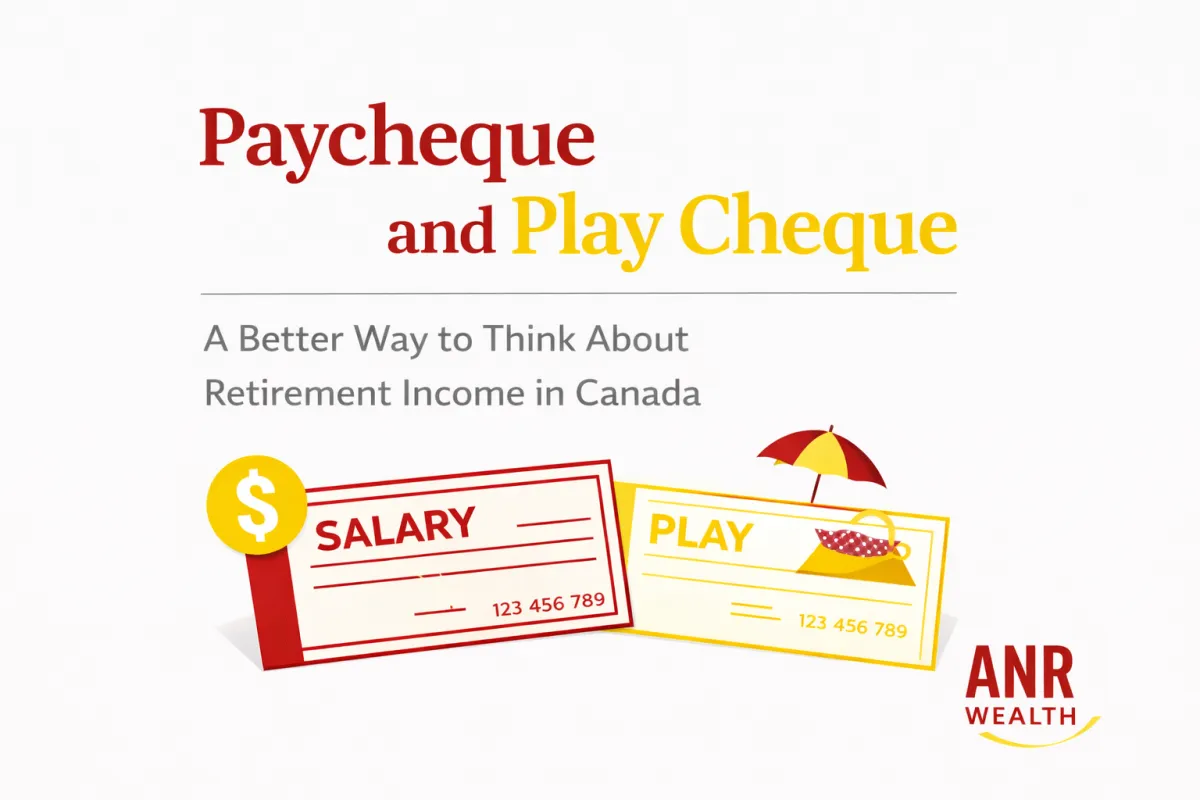
Paycheque and Play Cheque
A Better Way to Think About Retirement Income in Canada
Most Canadians arrive at retirement having done the hard part.
They saved. They invested. They made it.
What they haven't done — and most don't realize until they're there — is figure out how to turn what they built into income that actually works.
That's not a criticism. Accumulation has a clear goal: grow the number. Retirement income is a different problem entirely. The goal isn't growth anymore. It's reliability. Across decades. Through market cycles. Through health changes. Through whatever life decides to bring.
And most plans aren't built for that.
They're built for accumulation — then left to figure out the rest.
The Belief Most Retirees Carry In
"I've saved enough. The income will sort itself out."
That belief holds — for a while. CPP starts. OAS kicks in. You draw from savings. It feels manageable.
Until markets drop in year two and the portfolio takes the hit right when you need it most.
Until one spouse needs care and the same pool that was funding travel is now funding a care facility.
Until OAS gets clawed back because nobody modelled the income properly and withdrawals pushed the threshold.
None of these are edge cases. They're the standard retirement experience for plans without structure.
The problem isn't the savings. It's that all of it — guaranteed income, invested assets, lifestyle spending, essential expenses — is sitting in one undifferentiated pot. And one pot can't show you where the gaps are.
A retirement income plan isn't a number. It's a structure.
Two Problems. Two Pools.
When you look at retirement income clearly, it's actually two separate problems that most plans treat as one.
The first problem: how much income do you need every month to cover non-negotiable expenses? Housing costs. Groceries. Utilities. Insurance. The costs that don't move even when markets do. This is your floor. It needs to be funded with certainty.
The second problem: what funds the life you actually built this for? Travel. Experiences. Helping the kids. Giving generously. Building a legacy. This is your lifestyle pool. It needs to be invested and managed to last.
Different problems. Different sources. Different levels of certainty required.
That's the foundation of the Paycheque and Play Cheque framework.
The Paycheque
The Paycheque is your income floor.
Not a product. Not a specific account. A target.
You start by identifying what non-negotiable monthly expenses actually are. Then you build toward that number using whatever combination of sources makes sense for your situation — CPP, OAS, a defined benefit pension, annuity income, RRIF draws, TFSA withdrawals, corporate dividends. The sources are flexible. The floor is the goal.
The key is reliability. The Paycheque is income structured to cover the baseline every month — regardless of what markets do, regardless of what else is happening. When it does its job, a bad year in the market doesn't threaten your ability to pay essential expenses.
Most Canadians have building blocks for a Paycheque. CPP and OAS provide a starting point. The real question is whether those sources alone cover the floor — and if not, what combination of income and withdrawals closes the gap in the most tax-efficient way possible.
That's a coordination question, not a product question. The answer looks different for every household depending on what they have, when they need it, and what the tax picture looks like.
The Play Cheque
The Play Cheque is what remains once the floor is funded.
The capital sitting above the Paycheque — in whatever accounts hold it — becomes the Play Cheque. Its job is to fund lifestyle spending. The things retirement is actually for.
Because the floor is already covered, the Play Cheque has room to stay invested. It doesn't need to be drawn down under pressure. It doesn't need to fund groceries when markets are down 20%. It can be managed for longevity rather than for survival.
The floor keeps you safe. The pool keeps you living.
The Play Cheque isn't a fixed account either. Depending on how the floor is funded, the same TFSA or investment account might contribute to the Paycheque in some years and represent Play Cheque capital in others. What matters is the purpose the capital is serving — not the label on the account.
This is an important distinction. The framework isn't about sorting accounts into boxes. It's about having clarity on what each dollar is doing and why.
Where Plans Quietly Break
Most retirement plans don't fail dramatically. They erode slowly, in ways that don't show up until the damage is done.
Here's what that looks like.
A couple retires at 62 with $900,000 in savings, CPP coming for both, OAS starting in two years for one of them. On paper it looks fine. In practice, the invested portfolio is carrying both essential expenses and lifestyle spending from day one. One pot. No floor. No separation.
Year two, markets drop 22%. Now they're selling investments at a loss to cover property tax and groceries. Sequence of returns risk — the damage done by drawing from a declining portfolio early in retirement — quietly compresses the long-term runway. The math that looked fine at 62 starts looking different at 72.
Or one spouse is diagnosed with a serious illness at 68. Care costs arrive. The same invested pool absorbs it. Withdrawals accelerate. RRIF minimums combine with increased draws and push income above the OAS clawback threshold. The retirement they planned for is now funding something they never planned for.
Nothing was wrong with any individual piece. Everything was wrong with how the pieces connected.
The Paycheque and Play Cheque framework doesn't eliminate these risks. It makes them visible and manageable before pressure forces the conversation.
For Incorporated Business Owners
The framework becomes more complex — and more important — for incorporated business owners approaching retirement.
Corporate retained earnings represent a significant pool of capital that sits outside the personal balance sheet. How and when that capital moves — as salary, dividends, capital gains distributions, or through insurance strategies — has direct implications for how the income floor gets funded and what remains in the lifestyle pool.
Drawn down in the wrong order, it creates unnecessary tax exposure. Left too long, it misses optimization windows. Integrated into the two-pool framework alongside personal accounts, CPP, and OAS, it becomes a strategic asset rather than a tax problem waiting to happen.
The coordination between corporate structure, personal income, and retirement income sequencing is where integrated planning creates real value. Each decision affects the others. The floor you can fund, the tax you pay getting there, and the pool you have left are all connected.
Treating them separately — which is what happens when the accountant, the investment advisor, and the insurance advisor aren't talking to each other — is where the leakage happens.
What a Coordinated Income Structure Actually Looks Like
When the framework is built properly, a few things become clear that weren't before.
You know what your floor is. You know whether existing and future income sources cover it on their own, or whether additional draws are needed and from where. You know the tax implications of funding the floor from different sources in different years — and which sequence creates the least drag over time.
You know what sits in the lifestyle pool, how it's invested, and how long it needs to last given realistic spending assumptions. You know what happens if one spouse dies — whether the floor still holds on one set of income sources, whether the pool remains intact, whether the structure survives the transition.
You also know what the picture looks like at the end. RRIF tax at death, capital gains on secondary property, estate administration costs — these become visible within the structure rather than surprises the estate discovers under pressure.
This is what retirement income planning looks like when the pieces are actually connected.
The Question Worth Asking Now
Most people approaching retirement have savings. Most have CPP coming. Some have pensions. Some have corporations.
What most don't have is a clear answer to a simple question: what is my income floor, does my current structure fund it, and what role does the remaining capital play?
That gap is fixable. It's far easier to build the structure before retirement than to rebuild it under pressure after something forces the issue.
Savings get you to retirement. Structure gets you through it.
Frequently Asked Questions
How much income do I need in retirement in Canada?
It depends on your non-negotiable monthly expenses — the costs that exist regardless of lifestyle choices. Most retirement income planning starts by identifying that floor clearly, then working out which income sources fund it. A common starting point is 70% of pre-retirement income, but that number is less useful than an honest accounting of what your actual fixed expenses are.
What is the Paycheque and Play Cheque framework?
It's a retirement income approach that separates the income needed to cover non-negotiable monthly expenses (the Paycheque) from the invested capital that funds lifestyle spending (the Play Cheque). The goal is clarity about what each dollar is doing — and making sure the floor is funded before lifestyle spending begins.
How do I create retirement income from my savings in Canada?
By identifying your income floor first, then determining which sources — CPP, OAS, pension, RRIF draws, TFSA withdrawals, annuity income, corporate dividends — fund it most tax-efficiently. What's left becomes the invested lifestyle pool. The sequencing and tax planning involved in that process is where coordinated advice makes a significant difference.
What sources make up the Paycheque?
Whatever combination covers the floor for that person. CPP, OAS, pension income, annuity income, RRIF draws, TFSA withdrawals, corporate dividends — the sources depend on what's available and what's tax-efficient for that household. The Paycheque is a target, not a product.
What is the Play Cheque?
The invested capital remaining above the floor. It funds lifestyle spending — travel, experiences, generosity, legacy — and can be managed for long-term growth because it isn't carrying the weight of essential expenses. The same account can serve either role depending on how the floor is funded.
Why does this matter for incorporated business owners?
Corporate retained earnings add a layer of complexity and opportunity. How they're drawn down affects both the floor and the lifestyle pool, and the tax implications of different withdrawal strategies are significant. Coordinating the corporate and personal sides — along with CPP, RRIF, and estate planning — is where integrated planning creates real value that siloed advice misses.
Can I build a retirement income structure on my own?
You can identify the framework. Building it — including tax sequencing, account optimization, corporate integration, and estate alignment — requires the kind of coordination that only works when tax, investments, insurance, and estate planning are working from the same picture.
Related Reading
Planning for retirement income also means thinking about what happens to the structure at the end. Read our guide on life insurance after 65 in Canada, including RRIF tax exposure at death and estate liquidity planning.